
JAN
INTRODUCING
JANUARY 2025
In the Christian calendar January begins with a journey’s end and the satisfaction of a prophecy fulfilled. Following on fast comes the preoccupation with ‘what next?’ as we scan the empty pages of the year’s book just opened.
Word and images mix in this inaugural edition of SEEK THE SACRED, in a focus under ART on first, a painting depicting the challenge, dimensions and gritty texture of the Magi’s journey, and then on one conveying the complex mood of the scenario that results from their arrival.
Under LITERATURE hear how the voices of poets past and present describe these events.
Personally, the poetry will always conjure up for me how the Magi’s coming is put over in the 1964 film by Pier Paolo Pasolini The Gospel of St Matthew, Pasolini’s grainy black and white cinematography with its plein air settings and minimal soundtrack giving us what is on the one hand so apparently commonplace, while on the other so utterly confounding.
In the PEOPLE section you’ll be introduced to powerful C17th century preacher LANCELOT ANDREWES.
In this, as every edition, my aim is to explore the CONNECTIONS that can make things more meaningful and rewarding.
I am adding a SOURCES list at the end for follow up and further study, should anything you’ve read make any sparks fly.
This comes after the PLACE section which begins with beauteous Bath and a beloved garden under snow, seguing then into a general piece which includes a podcast on the impact the design of such green places can have on us, concluding with an assortment of green jottings and sayings.
AND INFO RE AN EXTRA:
By the way, you can also enjoy the music of this season too, thanks be to technology…! Through accessing the St Martin’s Digital website you can stream January 9th’s 40 minute concert performed at St Martin in the Fields, London.
Directed and led by Andrew Earis, this is entitled: Great Sacred Music: The Three Kings and billed as ‘a sequence to speak to the heart, head and soul, expressed through songs and readings, celebrating the great classical music of our religious heritage.’
ART OF THE MONTH
In the calendar: Epiphany for Western Christians is when the uncertainty, waiting and watchfulness of the preceding weeks have been brought to an end by the Nativity.
In their epiphany, the meeting at the Magi’s journey’s end with the infant Jesus is the manifestation they have sought to witness, the encounter with divinity which they are to recognize and adore: Christ revealing himself to them as incarnate, both fully God and fully human.
Despite having only one mention in the New Testament Gospels, the significance of the journey of the Magi is pivotally important in Christian iconography, having preoccupied religious artists since the religion’s earliest days.

The subject: Three camel caravans converge in the desert. Three royal entourages near the end of an arduous journey are led by their three gloriously-robed kings, Caspar, Melchior and Balthasar, up out of a shadowed Dead Sea valley on their final approach to Bethlehem.
The frame of reference: The Gospel of Matthew, Chapter 2, vs 1-12 describing the Magi’s journey, tells of the star that ‘.. went ahead of them, that they had seen at its rising.’ These Kings from the old world have believed a prophecy and are following it from afar, seeking a new king of the Jews. Their tributes: gifts of gold, frankincense and myrrh, are secreted in their tasselled saddlebags.
The artist: Famed as a society portraitist in Paris and London, James Tissot (1836 -1902) found his life totally changed when in 1885 he was powerfully affected by a vision of a suffering Jesus. Re-converting to the Catholic faith of his childhood, Tissot devoted himself to depicting his Saviour. Spending the late 1880s in the Holy Land, eventually producing 365 paintings of New Testament episodes in a series entitled The Life of Christ, he traversed the landscape obsessively, often on muleback, to capture and recreate the Biblical era’s realities, its shape, texture and details, in order he could claim his works bore ‘the stamp of truth.’
The painting: This is a small (20 x 29 cms) but completely arresting oil painting. Looking into The Magi Journeying it’s as though we’ve ridden out with Tissot into the parched Sinai’s bleached morning light and stand with him, feeling beneath our feet the rough boulder-strewn track. Tissot’s consummate use of perspective obliges us to raise our eyes above the camels’ reared heads to where the noble, turbaned Magi’s gaze is coolly measured, commanding ours. Tissot’s portrayal, arguably by far the finest in his entire series, is a masterwork of empathy with these men’s prestige – and with their humanity. Wearied by the gnawing worry all may prove futile, ‘Were we led all this way for folly?’ captured in the poem by TS Eliot (see LITERATURE) these kings are yet anticipatory of discovering a marvel which will be a cause of rejoicing for the world.
In 1900 the Brooklyn Museum in New York City, USA bought the entire The Life of Christ series, where it is still on show today.

The subject: The indefatigable star has stayed with the Magi until their goal’s been reached. They’ve ridden on horseback to see for themselves this Messiah, whom they venerate as they present their fabulous gifts. The crumbling Roman ruin of the setting symbolizes that this birth will bring about a new order, the end of paganism, while the louring sky foretells troubled times lying ahead – yet there’s the promise of hope contained in the gleaming dawn light on the eastern horizon.
The frame of reference: The Gospel of Matthew, Chapter 2, vs 11 says ‘On entering the house, they saw the child with Mary his mother; and they knelt down and paid him homage. Then, opening their treasure chests, they offered him gifts of gold, frankincense, and myrrh.’
The artist: Jacopo Bassano (1510-92) was in the middle of his long painterly life when he created this work in the late 1560s. Contemporary of Titian and Tintoretto, his beginnings in Venice, his late Italian Renaissance paintings exhibit several distinct phases. The work’s elongated figures and contorted poses suggest it was Mannerism he was following at this time. Once returned to his northern Veneto town of Bassano where he was to found a successful studio with his four sons and remain all his life, he repetitively featured the surrounding countryside he loved, Monte Grappa as in the background here a frequent element, along with highly sympathetic portrayals of animals, as in the Magi’s noble mounts, the hunting hounds and the gentle-eyed donkey.
The painting: Highpoint of Bassano’s achievement in this sizeable painting (94 x 130 cms) is his magnificent study in character, the different preoccupations depicted so tellingly in each expression: curiosity, wonderment, awe from the Kings and their entourage – with perhaps an undertone of relief at their arrival; Mary a cautious mother holding her child close; Jacob showing pride but also perplexity about what this pomp and circumstance portends. The composition taut and complex, interrogating it we observe how each character’s on high alert, each displaying a different dimension of enquiry. Entirely focussed on the Christ child’s innocent sleep in this present moment of prophecy fulfilled, the work’s overarching effect is yet not triumphant, hinting rather at the future, uneasy, unknowable.
LITERATURE
There is a soundtrack to the Magi’s journey – there are two in fact.
The text below is from the most renowned poem describing it.
First, hear it in the poet’s voice:
Journey of the Magi

JOURNEY OF THE MAGI
by T S Eliot
‘A cold coming we had of it,
Just the worst time of the year
For a journey, and such a long journey:
The ways deep and the weather sharp,
The very dead of winter.’
And the camels galled, sore-footed, refractory,
Lying down in the melting snow.
There were times we regretted
The summer palaces on slopes, the terraces,
And the silken girls bringing sherbet.
Then the camel men cursing and grumbling
And running away, and wanting their liquor and women,
And the night-fires going out, and the lack of shelters,
And the cities hostile and the towns unfriendly
And the villages dirty and charging high prices:
A hard time we had of it.
At the end we preferred to travel all night,
Sleeping in snatches,
With the voices singing in our ears, saying
That this was all folly.
Then at dawn we came down to a temperate valley,
Wet, below the snow line, smelling of vegetation;
With a running stream and a water-mill beating the darkness,
And three trees on the low sky,
And an old white horse galloped away in the meadow.
Then we came to a tavern with vine-leaves over the lintel,
Six hands at an open door dicing for pieces of silver,
And feet kicking the empty wine-skins,
But there was no information, and so we continued
And arrived at evening, not a moment too soon
Finding the place; it was (you may say) satisfactory.
All this was a long time ago, I remember,
And I would do it again, but set down
This set down
This: were we led all that way for
Birth or Death? There was a Birth, certainly,
We had evidence and no doubt. I had seen birth and death,
But had thought they were different; this Birth was
Hard and bitter agony for us, like Death, our death.
We returned to our places, these Kingdoms,
But no longer at ease here, in the old dispensation,
With an alien people clutching their gods.
I should be glad of another death.
PEOPLE


‘Just the worst time of the year for a journey…the very dead of winter.’ These are phrases incorporated by T S Eliot into his celebrated poem but which do not originate from him. Rather, they are direct transpositions from the Nativity sermon of Christmas Day 1622 given in front of King James 1 in Whitehall by BISHOP LANCELOT ANDREWES.
Nigh on three hundred years separate the sermon and the writing of Eliot’s poem in 1927, the year when the poet was baptised into the Anglican faith.
In borrowing the lines no attribution to the Bishop was made by Eliot – but that same year he did dedicate him a collection of essays which he entitled For Lancelot Andrewes.
Andrewes (1555-1626), whose effigy in Southwark Cathedral is shown above, was a theological scholar honoured as the most learned churchman of his day.
Dean of the Chapel Royal when he gave the sermon, he’d risen through the church during Elizabeth 1’s reign. On James I’s accession in 1603, the Church of England entering a period of relative calm after the turbulence brought about by the Elizabethan Religious Settlement, Andrewes’ career entered a fortunate phase, during which he frequently preached before James, a tolerant and theologically-learned Presbyterian monarch.
A profound thinker and an eloquent and impassioned preacher, Andrewes’ sermons have been praised as containing ‘passages of extraordinary beauty’.
‘Gratitude is the praise we offer God’, Andrewes wrote.
Here is one of his prayers, demonstrating how humbly the Bishop petitioned his Lord for spiritual aid: Have mercy on Lord, for I am weak: remember Lord, how short my time is; remember that I am but flesh, a wind that passeth away, and cometh not again. My days are as grass, as a flower of the field; for the wind goeth over me, and I am gone, and my place shall know me no more.
Now, consider this set of CONNECTIONS: while James Tissot was in the Holy Land in 1888 making preparatory sketches for his The Magi Journeying how probable is it, that back from his strenuous field research when in his study in Jerusalem of a quiet evening, his avid reading should have included Andrewes’ Christmas Day and other sermons?
Then how likely is it Eliot the poet had familiarised himself with Tissot’s art? Might he have registered that the artist had depicted the Magi’s progress as having left behind the ‘melting snow’ but, in the first hours after sunrise, their guiding star extinguished in the daylight, they had not yet reached the ‘temperate valley’ that he would go on to describe?
To close this circle, we have the evidence Eliot read and admired Andrewes. During those bleak interwar years when he was constructing his Magi poem, writing in the wearied, apprehensive voice of the modern European intellectual, let us imagine him drawing comfort from the Bishop’s staunch faith.
And let’s let poet Malcolm Guite have the last word on the linkages around Epiphany, Eliot and the Magi that this edition of STS has set out to show.
Guite, affirming that religious art is the product of ‘an imaginative grasp of faith and an imaginative proclamation of faith’s tells us, ‘All great art is a bridge with one foot…in the visible, the earth, and one in the invisible, heaven.’
Making his own erudite set of connections, the second soundtrack for Eliot’s poem is here, read in Guite’s inimitable style.
PLACE
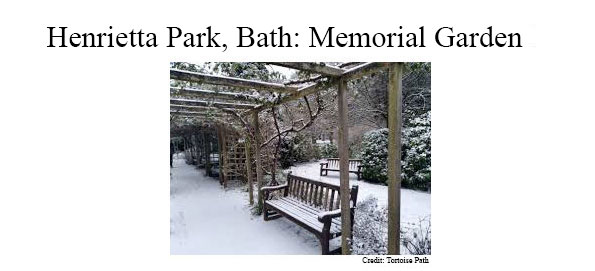
Snow, that was one of the arduous factors involved in the Magi’s journey that was to be characterised by the phrase ‘the hard coming’ that Andrewes and Eliot use to describe what the three Kings went through. In Eliot’s poem the exhausted camels lie down in it, loath to trek on.
Snow is a January hazard and January 2025’s sub-zero temperatures as experienced in the UK are proving to be both hard and difficult, as well as life-threatening.
Appreciation of the purity and sheer sparkling beauty of snow is often short-lived when it disrupts daily life and presents threats to walkers, drivers and wildlife, the cold accompanying it putting the frail and less fortunate at real risk.
Snow on a garden – if even only for the few brief moments it remains unsullied by footprints or thaw, it has to be admitted is something special, though.
My picture above is of the Memorial Garden in Henrietta Park in Bath, UK.
Always a quiet place, under snow it is soundless now except for the twittering of small birds and the ‘chitter, chitter’ of magpies. There are 7 hectares of parkland to enjoy on winding paths under many magnificent trees.
Under the overall care of Bath and North East Somerset Council, the Park benefits from the work of The Friends of Henrietta Park https://henriettapark.org a group who come regularly on a voluntary basis to weed and maintain the garden and clear it of litter.
The Quiet Garden Movement https://quietgarden.org accords gardens a sacred place, praising them for the opportunities they offer for ‘silence, stillness, prayer and contemplation in the Christian tradition, in the natural environment.’
The Movement, coordinated by the Quiet Garden Trust, coordinates urban and rural locations which are open free of charge to those who wish to enjoy their peace and find there the peace they seek. There are now more than 300 Quiet Gardens in 18 countries
The concept of the Sacred Garden in Christianity and Islam is discussed in this podcast from BBC Radio 4’s Beyond Belief programme.
Hear Ernie Rea in conversation with guests here.
SAYINGS AND JOTTINGS
‘Come with me by yourselves and get some rest’ said Jesus in The Gospel of Saint Mark, Chapter 6, vs 31.
In a well-known hadith the Prophet Mohamed declared, ‘If you pass by the Gardens of Paradise, graze therein.’
Pope Benedict XVI (2005-13) said ‘Visiting a garden one is amazed by the variety of plants and flowers. Often when there one is drawn to think of the Creator who has given the earth a wonderful garden.’
Here is part of Monty Don’s introduction to his luscious BBC Two series on Paradise Gardens. ‘At Pasargae in the Iranian desert lie the ruins of Cyrus the Great’s C6th century palace. The garden was divided into four, representing the sacred elements of water, wind, earth and fire. It was these Zoroastrian gardens that were to inform the ideas of the future, not only of what a garden should be, but of Paradise itself.’
On a gap year in Israel this is what I wrote in my journal about the garden on the Mount of Olives, ‘I travelled a dusty road winding upwards through countryside coloured ochre.. Pausing before reaching the Holy City, I gazed across at the shimmering vista of Jerusalem’s ancient walls and saw the shrine of the Dome of the Rock glinting gold against white hills. I climbed to a high ridge to imagine the Mount cloaked green with olive groves. In my mind’s eye I was where Jesus, despairing of Jerusalem that night, sought the quietude of Gethsemane’s Garden for a vigil of prayer amongst the ancient trees.’
SOURCES
Taylor Charles, A Secular Age (Harvard, Harvard University Press 2007)
Wood Christopher, Tissot: Life and Work of Jacques Joseph Tissot 1836 -1902 (London, Weidenfeld and Nicolson 1986)
Dolkart Judith F (ed), James Tissot: The Life of Christ, the Complete Set of 350 Watercolours 1886-1896 (Catalogue Brooklyn Museum), (London, New York, Merell 2009)
Ballarin Alessandro and Ericani Giuliana, Jacopo Bassano (Milan, Mondadori Electra 2010).
Eliot TS, Journey of the Magi (London, Faber and Gwyer 1927)
Lancelot Andrewes Christmas Day Sermon 1622 https://jimfriedrich.com/tag/lancelot-andrewes-christmas-sermon-1622/
Guite Malcolm, Lifting the Veil: Imagination and the Kingdom of God (Baltimore, Square Halo Books 2021)