
FEB
FEBRUARY 2025
February, somehow the darkest month, despite knowing Spring is not far now.
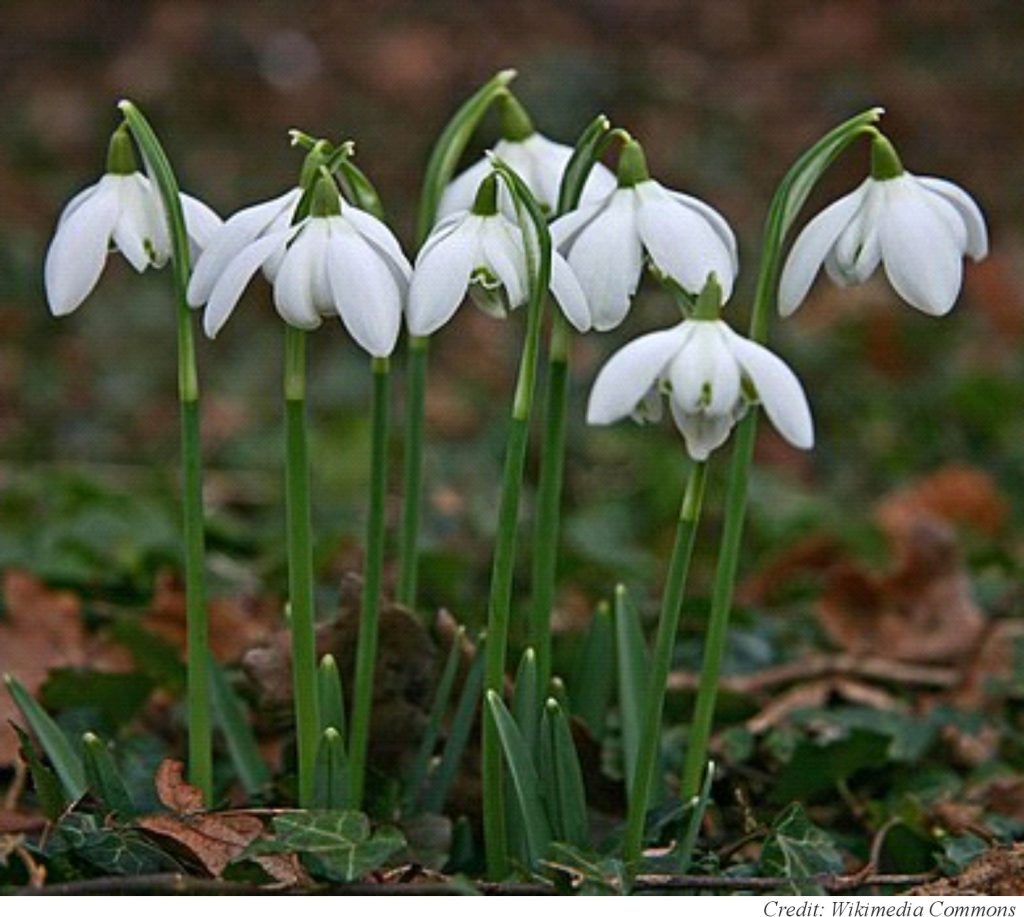
On February 1 it’s the pagan festival of Imbolc: denying the gloom, celebrating renewal and transformation, seeing signs of the winter’s ending in the earth’s awakening – specifically the first snowdrops beginning to push their way up.
In Ireland, it’s La Fheile Bride, St Brigid’s Day, also marking the beginning of spring.
And it’s the celebration of the Festival of Candlemas.
Putting a match to a candle, dispelling the dark so that its light fortifies us, reminding us of a promise to be fulfilled, that’s what Candlemas is for, a time for blessing and distributing candles.
It’s also the Festival of the Presentation of Christ in the Temple (in the ART section see how Rembrandt tenderly portrays the aged Simeon opening his mouth to give praise.) Rembrandt captures Simeon’s awe at the revelation he’s received. Only in a burst of spontaneous song can his joy and relief be expressed. Beginning with, ‘Lord, now lettest thou thy servant depart in peace,’ he gives us the comfort-filled phrases of the Nunc Dimittis sung in Western Christian churches’ Evensong services.
This month a MUSIC section is devoted to the rapture of song, in particular to George Frederick Handel and his composition, Messiah. Musicologist Charles King describes Handel’s Messiah as very probably ‘the most sacred act that a mass secular audience will ever undertake.’ He writes of it as intimating something of the nature of the infinite, as ‘capturing the essence of wonder’ as being ‘…the greatest piece of participatory art ever created…’
Old Testament prophet Isiah commands the herald, ‘Lift up thy voice with strength’ (Isiah Chapter 40, verse 9).
This is a command you may well have heeded when joining full-throated in an exultant Hallelujah chorus from Handel’s Messiah at the concerts that have happened worldwide this Christmas season past.
Hear Isiah’s command as transcribed from the Old Testament by Charles Jennens and rendered by Handel in his Messiah.
Music courtesy of The Falls Church Anglican Choir, Falls Church, Virginia, under the musical direction of Simon Dixon. Audio mastering by Andrew Schooley. From Messiah by George Frideric Handel (1742)s leo.
In LITERATURE you’ll find a poem intensely powerful in its brevity. This is Candlemas by Denise Levertov. Levertov’s challenging life circumstances, and how they and her spiritual journey can be traced in her poetry are the subject of the PEOPLE section.
Under PLACE we enter Westminster Abbey’s hallowed portals. In this edifice which has stood at London’s heart for 960 years, where kings and queens have been crowned (40 since 1066), wed and buried, and artists of all kinds celebrated, there are CONNECTIONS to be pursued
ART OF THE MONTH
In the calendar:
The Presentation of the Christ Child takes its date from the forty days which have passed since Jesus’ birth in Bethlehem. This is when his parents, Mary and Joseph, are obliged to meet their legal obligation to present their child at the Temple in Jerusalem. Devout and righteous Simeon has been eagerly waiting for the fulfillment of the prophecy of a Messiah to come. The Holy Spirit has revealed to him he will not die until he has seen this Messiah. As Mary and Joseph enter the Temple, Simeon, recognizing the baby’s sanctity and taking Jesus in his arms, raises his voice in song to praise God, expressing the relief and joy in his heart.
SIMEON’S SONG OF PRAISE by REMBRANDT VAN RIJN

The frame of reference: The Gospel of Luke Chapter 2 verses 25-35 describes Mary and Joseph coming to the Temple in Jerusalem to present their child, as the law requires. They encounter Simeon. Having recognised the Christ Child as the Messiah he’s been waiting for and taken the baby in his arms, Simeon praises God with these words, ‘Lord, now lettest thou thy servant depart in peace, according to thy word. For mine eyes have seen thy salvation, which thou hast prepared before the face of all people. A light to lighten the Gentiles, and the glory of thy people Israel.’ His words indicate that he is now ready to die, having witnessed the sight the prophecy promised him.
The artist: The life of Rembrandt (1606-1669), the greatest Master of the Dutch Golden Age, was tumultuous. He experienced great shifts in his personal fortunes, having achieved renown in his youth as a portrait painter before broadening his repertoire to include many genres. Despite the troubles of his later years’ private life, including bereavement and bankruptcy, his reputation remained intact until his death, his output rather increasing in gravitas and emotional impact. Later Rembrandt work is characterized by experimentation, command of the effects of light, his profound insights and capacity for expressing intimacy. Laura Cumming in The Guardian describes the artist as ‘the outstanding chronicler of the human face ..whose imagination can get into the heart of any human life’ and one ‘who turned paint into gold. ’
The painting: With this (today in the Nationalmuseum, Stockholm) painting has not Rembrandt’s humanity reached its apex? In this, his last, begun in the year of his death but left unfinished, created while contending with his own crushing losses of loved ones, Rembrandt shows us in Simeon the epitome of age, stricken and frail, depicting this in acute contrast to the Christ child’s demeanour, composed despite his vulnerability. Initially, the portrayal seems of something apparently sombre, inward – looking deeper we’re alerted we’re to witness the joy in Simeon’s song, which spontaneously, poignantly will express his gratitude to God. Rembrandt’s pigment is loaded densely, his brushwork loose, his colours blur against a gloomy background. Through the inspired use of these elements, along with the rosy beams deployed to alight on and delicately illuminate Simeon and Jesus, the anguished anticipation of the great change that’s to come in the world is brought home, we the audience shown the very core of this transcendent second great Christian revelation.
(Other late Rembrandts are described by Simon Schama with his inimitable precision and verve in the 1 hr video Masterpieces of the Late Years dailymotion.com/video/x290mmx?start=1986)
MUSIC
GEORGE FREDERIC HANDEL (1685-1759)

LITERATURE
CANDLEMAS
by Denise Levertov
With certitude
Simeon opened
ancient arms
to infant light.
Decades
before the cross, the tomb
and the new life,
he knew
new life.
What depth
of faith he drew on,
turning illumined
towards deep night.
PEOPLE
DENISE LEVERTOV (1923-97)

Every evidence in Denise Levertov’s poetry, its lucidity, sensitivity and the effect of its layered, cumulative power, indicates that she had a mind unfettered by convention. A phrase used about Levertov’s life is that she lived it ‘with the door of her heart open.’
Born in the UK, never having attended school, her formal education ceased at age twelve, although cultural references abounded in her polymath family’s home: her writer father a Russian Jew who had converted to Christianity, her mother of Celtic origins, highly literate. Levertov’s first book was published post-WW2 in 1946, her poetry already hinting at the militant pacifism that was to engage her fully, along with activism in relation to nuclear disarmament, racism and ecological concerns. Later in her career she was to share her honing of her craft by teaching and translating and editing poetry journals in her adopted country, the USA.
This is the opening stanza of Levertov’s title poem Making Peace from the anthology of the same name published by New Directions (New York) in 2006.
A voice from the dark called out,
‘The poets must give us
imagination of peace, to oust the intense familiar
imagination of disaster. Peace, not only
the absence of war.’
Written twenty eight years ago in 1997, the year of Levertov’s death, it is timeless in that it represents a compassionate clarion call which could be issued on any day in our troubled present.
The poem commands poets to create a new narrative of peace, one that challenges the discourse of war and disaster with which the press and media are filled. It argues that peace, like poetry, has to be constructed, through language and through action.
Explicitly political, reflecting the social and historical context of the Vietnam War, against which Levertov was a vocal protestor, the poem represents a veering away from the personal tone of voice in which she had expressed her earlier years’ agnosticism and finely-tuned social and political consciousness. It has been said of Levertov’s work that her mysticism was always grounded in Christianity but it was not until 1990 that she converted to Catholicism, a process described as ‘discovering God in the discovery of herself.’
Even in 1992 with the publication of her collection ‘Evening Train’ her subjects still ranged widely, going beyond religion to reflect her poetic integrity in the inclusion of problems of personal conscience and demanding social issues such as racism and the AIDS pandemic.
One of the six poems Levertov reads in the 1993 video below of an event at the Lannan Foundation in Los Angeles includes the line ‘Have I said already all I have to say?’
The poet is in her early 70’s by now, expressing vulnerability, highlighting the fear plaguing the aging that they are used-up, redundant. Tellingly, she responds to her own question by requesting her readers, ‘Remember Cezanne… Remember James (Joyce).’ She’s reminding them how these artists persisted in pursuing perfection, via potentially obsessive repetitions, yes, ‘to get it right’, but also as Levertov commands, because there’s no alternative – as an artist she declares, ‘You must proceed..’
Composing poetry almost until the moment of her death, forty poems were published in a posthumous collection, This Great Unknowing. A reviewer summing up the collection wrote in Sojourners magazine that the work represented the ‘passion, lyrical prowess and spiritual jubilation’ that characterised Levertov’s existence, a pilgrim in the world, her imaginative genius always geared to exploring eternal questions.
DENISE LEVERTOV READS SIX POEMS
Denise Levertov: six poems
PLACE

WESTMINSTER ABBEY
For almost one thousand years the rush, tumble and tumult of London street life has been passing by outside this window at Westminster Abbey, pictured above.
Take a look at this brief – but very beautiful – video which makes the case for why you should stop, pause, and take yourself inside the ancient Abbey, to marvel and reflect on the sanctity of such places, which have mattered, have meaning, and where ‘prayer has been valid.’
CONNECTIONS
The links here are strong: Handel wrote some of his most celebrated music for performance in the Abbey, which across the centuries has hosted multiple performances of the Messiah. Buried a week after his death in April 1759, Handel’s tomb is in the Abbey’s Poet’s Corner where he is immortalised with a plaque and life-size sculpture by Louis-Francois Roubiliac, complete with carvings of musical score and instruments.
In 1791 1000 musicians gathered for a massive day-long Messiah performance while in 1874 for George III’s royal commemoration of the Maestro’s life there was a performance by 250 instrumentalists. On the 250th anniversary of his death in 2009 the number of instrumentalists was again fittingly 250.
On leaving the Abbey it’s an easy 20 minute connect to reach Handel’s London home, now a museum (described under MUSIC.)
From the ‘W’ bus stop outside the Abbey take the 88 and get off at the top of Oxford Street. You’ll see Liberty’s department store on your right. Stay on the left side of the road and make a turn into Hanover Street.
A 7-minute walk will lead you into Brook Street, number 25 is on the left.
On your way, crossing Hanover Square there’s a left hand turning where St George’s, Hanover Square is prominently in view, a fine church worth a detour. Probably its ‘best known parishioner of all times’ was Handel. By 1753 despite being blind and crippled with arthritis, he still attended services, a regular worshipper with his own pew, ‘expressing by his looks the utmost fervour of devotion.’
SAYINGS AND JOTTINGS
Praise for Percy Bysshe Shelley (1792-1822) from the Poetry Foundation tells us that this poet has ‘come to symbolize the free and soaring spirit of mankind.’ Here are the cheery lines Shelley wrote about February:
Bending from Heaven, in azure mirth,
It kissed the forehead of the Earth,
And smiled upon the silent sea,
And bade the frozen streams be free,
And waked to music all their fountains,
And breathed upon the frozen mountains
From The Guardian here’s a recommendation for a ‘favourite seasonal book’ from nature writer Robert Macfarlane:
Winter: Five Windows on the Season by Adam Gopnik (London, Quercus 2012) explores how winter and its officers – cold, frost, snow and ice – have shaped music, literature, art in especially the temperate zones of the northern hemisphere. Breughel The Elder’s Hunters in the Snow, Henry Raeburn’s The Skating Minister, Schubert’s Die Winterreise – they’re all here, in a blizzard of connections, excavations and wintry creations.
Contemporary poet Alice Oswald nominates as her choice of lines ‘written for cold spells’ the poem by John Donne (1572-1631) A Nocturnal upon St Lucy’s Day, writing that it is ‘A pitch dark poem for midwinter which is slowly illuminated by the blind Saint Lucia. In grief for his dead wife, Donne made a poem so vulnerable and yet so melodic and patterned with images, that the mind lifts even as it falls.’
And thanks to Katherine May for wrapping up this subject so well in her comprehensive book Wintering: The Power of Retreat and Rest in Difficult Times (London, Ebury 2024)
Thanks to The Marginalian newsletter@the marginalian.org for this final thought from Albert Camus’ Lyrical and Critical Essays,
‘In the depths of winter, I finally learned that within me lay an invincible summer.’
SOURCES
Brown Michelle P The Lion Companion to Christian Art (Oxford, Lion Hudson 2008)
Schama Simon Rembrandt’s Eyes (New York, Knopf, 1999)
Cumming Laura Thunderclap: A Memoir of Art and Life and Sudden Death (New York, Scribner, 2024)
King Charles The Desperate Lives and Troubled Times That Made Handel’s Messiah (New York, Doubleday 2024)
Hogwood Christopher Handel (London, Thames and Hudson 2024)
Levertov Denise The Collected Poems of Denise Levertov, Lacey Paul A (Editor), Boland Eavan (Introduction) (New York, New Directions 2024)