
NOV
Introducing
NOVEMBER 2025
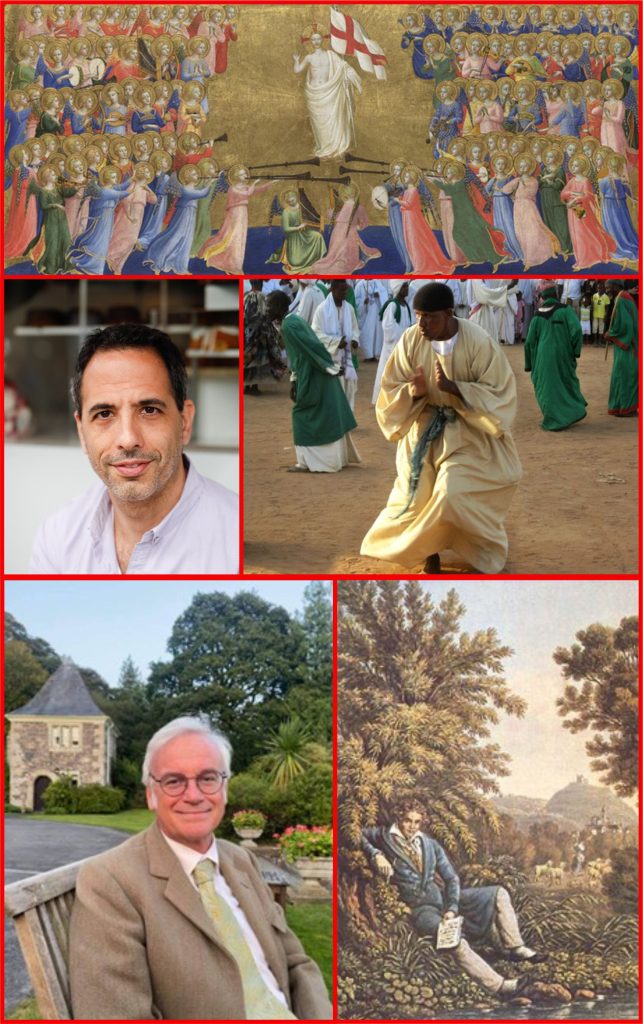
Joy is our STS theme for November.
As the northern hemisphere dips into its darkest months, joy is vital and is to be sought out wherever it can be found.
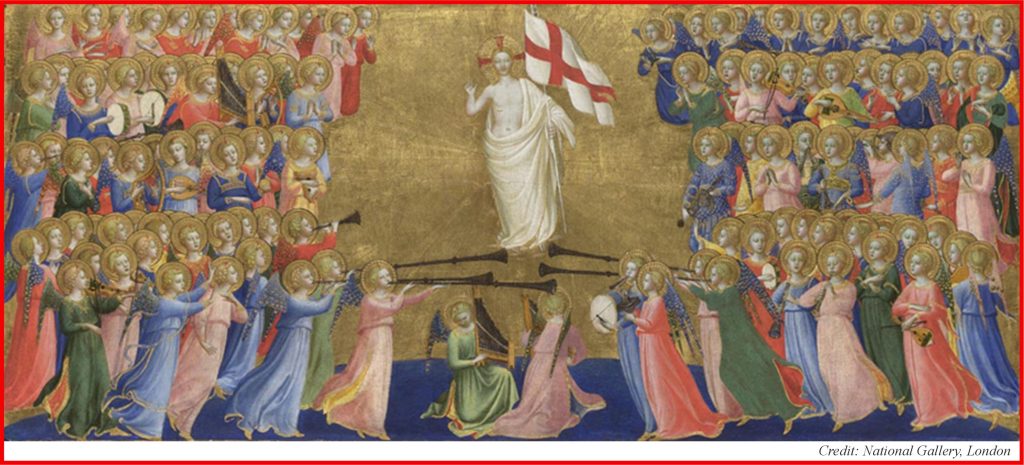
Some of that finding is very likely to be in music – and this issue’s special focus is on music. It opens under ART with a celestial orchestra painted all a-glint with gold by the Florentine Renaissance maestro Fra Angelico. The work depicts Christ ascended into heaven, celebrated by pink-cheeked angels playing a wonderful selection of instruments.
The instrument that is the human voice is a great source of joy: to singers (are not those of your friends who sing among the happiest people you know?) and of course, to their audiences.
Emma Pauncefort, the Director of the recording company CRD, concurs, writing, ‘The conjoining of human voices provides us with the ultimate source of comfort and joy’ (for more on CRD etc see the ENDNOTE below, which follows on from the contribution about JOYFUL MUSIC, choral in the most part, which musicologist Russell Blacker has made to the issue.)
Following Russell, there’s a celebration of that immortal creation, Ludwig van Beethoven’s ‘Ode to Joy’ from his Ninth Symphony, seen through the eyes of cultural blogger Maria Popova, whose relationship from youth with this rousing work is movingly described. Popova’s definition of joy fusing presence and possibility in her own life provokes thought.
‘The soul is here for its own joy’, teaches the poet Rumi (1207-1273) whose wisdom has held good for 750 years. In Rumi’s religion, Sufism, revelation is sought by sustained whirling, a serene, repeated motion promoting ecstasy. He urges, ‘Do not sit idle; leap into the fire of love.’ Leap too into dance, another unfailing route to feeling joy.
Nimira Shariff (shariff.nimira@gmail.com) is an artist based in Nairobi, Kenya, who became enthralled by the whirling of the dancers known as ‘dervishes.’ In a series of mixed media works she has sublimely captured the dignified spirituality of a lone dancer – equipoised between physical vigour and the rapture of revivification via revelation.
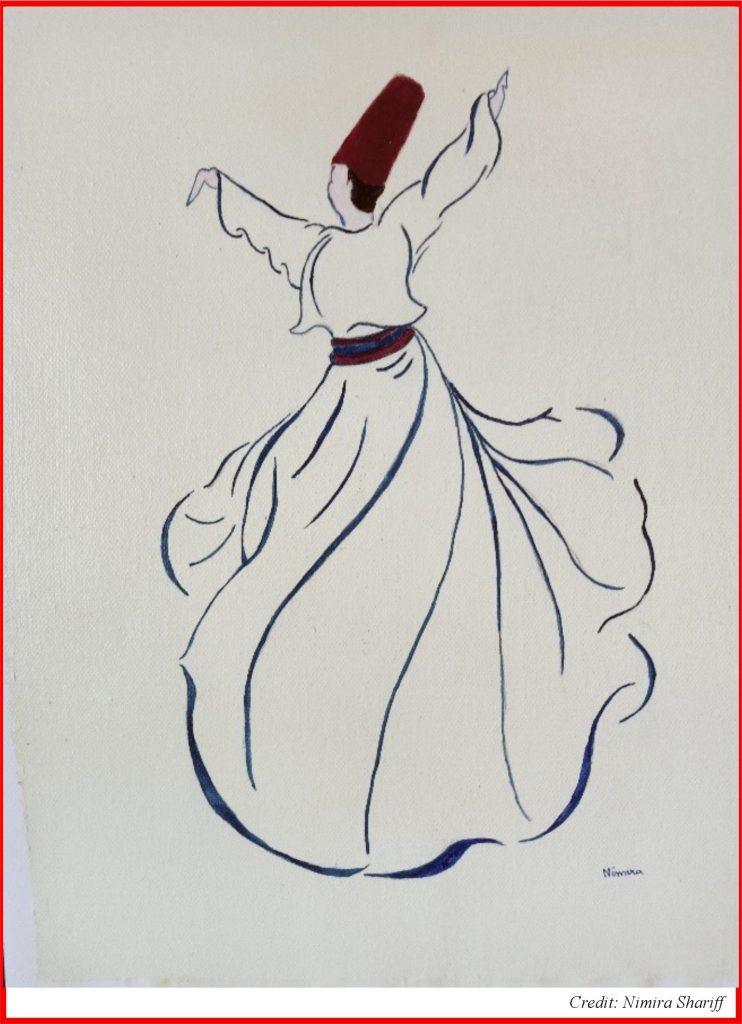
Nimira’s Sufi images draw on the performance style of whirling which can be seen in Turkey: in Konya, the dervishes’ spiritual home, and in venues in Istanbul. Here a group of ten or more uniformly-dressed dancers (white robes, tall conical back hats) will enter into a choreographed, steady, paced ascent to achieve their peak state of joy. In a quiet, low-lit space their audiences will be hushed and reverential.
In Sudan the Sufi sect also whirl as dervishes – but there, you’ll find presentation is somewhat different, as is recounted in our PLACE section. In this I describe a performance witnessed in Omdurman, a memory from a time very different from now.
And then PEOPLE – this is not the first time STS has referred to the sacredness of feasting and shared food but it is the first time a leading chef has been featured for his specific contribution to making food preparation and consumption more meaningful for many people. Yottam Ottolenghi: read on to see where he’s come from, where he may be going.
And courtesy of Ottolenghi, there’s another first for STS – a recipe. If you’re doubting whether this blog seeking out sacredness is the rightful place for reading about ingredients and cookery methods, well, just re-look at Russell’s piece, and note the quote he gives us from Saint Paul about the spiritual nourishment that comes from God, who ‘ .. provides you with plenty of food and fills your hearts with joy.’
And finally, sample a little nourishment of an intellectual kind from our NOTES & JOTTINGS section which offers up a variety of personal reflections on joy.
ART OF THE MONTH
CHRIST GLORIFIED IN THE COURT OF HEAVEN
by
FRA ANGELICO (1395-1455)
In the calendar:
For Christians, the Ascension means that Jesus, glorified, has rejoined the Father and prepares for the coming of the Holy Spirit which is celebrated at Pentecost. Jesus has ascended into heaven after rising from the dead, this act marking the end of his physical presence on Earth. Ascension Day is celebrated in the western church calendar on 6 May, the fortieth day of Easter. In November the days which celebrate the end of life on earth and the life everlasting are All Saints Day, 1 November and All Souls Day, 2 November. The former is specifically for remembrance of saints and martyrs. (This day is also the pagan Day of the Dead, also known as Samhain.) 2 November is All Souls’ Day, also called the Commemoration of the Faithful Departed.
The frame of reference:
The Ascension is recounted in several biblical texts, including:
- Acts of the Apostles Chapter 1, vs 6-11 ‘He was lifted up while they were watching, and a cloud hid him from their sight’
- Gospel of Saint Mark Chapter 16, vs 19 ‘The Lord Jesus, after speaking to them, was taken up into heaven and sat down at the right hand of God’
- Gospel of Saint Luke Chapter 24, vs 50-53 ‘Jesus blessed them, then parted from them and was taken up into heaven’
The painting:
The triumphant image of Christ Glorified in the Court of Heaven forms part of the predella from an altarpiece Fra Angelico made for the Friary of the order San Domenico in Fiesole, a village above Florence, which he had joined as a novice c1417.
In this depiction of a tumultuously joyful reunion Jesus is placed at the centre of the work’s blazing gold leaf radiating rays, white-robed and holding the banner with its red cross that signifies the blood of his crucifixion. Around him are the serried ranks of a heavenly host of halo-ed angels. Garbed in rose pink, soft green and blue, they lift their instruments to follow the instructions from this verse of Psalm 150,
‘Praise him with the sound of the trumpet: praise him with the psaltery and harp.
Praise him with the timbrel and dance: praise him with stringed instruments and organs.
Praise him upon the loud cymbals: praise him upon the high sounding cymbals.
Let everything that hath breath praise the Lord.
Praise ye the Lord.’
The predella is in London’s National Gallery and is a work in egg tempera on wood, 73 x 31 cms in size.
The artist:
One of the Early Renaissance’s principal painters, Fra Angelico’s work is first recorded in Florence in 1417. He lived out his life at the San Domenico Friary, eventually becoming Prior.
He is most renowned for the frescoes he painted in another friary. These works were begun after 1436 in the new Dominican friary of San Marco in Florence commissioned by Cosimo de Medici, where Angelico decorated each of the 50 monastic cells with his poignantly introverted works, some of which impact the viewer with the symbolic power of icons, and which remain on view to this day.
(The building is now the Museum of San Marco where its ground floor galleries house a significant collection of other Fra Angelico works, including several magnificent altarpieces.)
Fra Angelico began as a miniaturist, and this shows – against the luxurious and expansive settings of his larger works it is the delicacy of his touch and his acutely-rendered details within the compositions that draw the eye.
He was also influenced by early Renaissance work in Florence, particularly the sculpture of Ghiberti, and used new realism and impression of volume to define figures, as well as linear perspective, to define space and project his depictions of people in his own more private, inward-looking and contemplative art.
Of Fra Angelico John Ruskin said, ‘He is not an artist properly so-called, but an inspired saint.’
‘Fra Angelico’s works demand to be drunk in in silent contemplation’, states Spectator critic Matthew Bell, who however adds, ‘Not that you need to be devout to appreciate the quality of Angelico’s craft. There is something so kind and gentle in the faces he paints, their expressions full of pain or wonder.’
More than 140 works by Fra Angelico assembled from 70 different lenders across the world are on show in Florence for the current exhibition Beato Angelico at
The Palazzo Strozzi and Museo di San Marco
The exhibition runs until 25 January 2026.
JOYFUL MUSIC
AN INTRODUCTION
by
DR CV RUSSELL BLACKER…
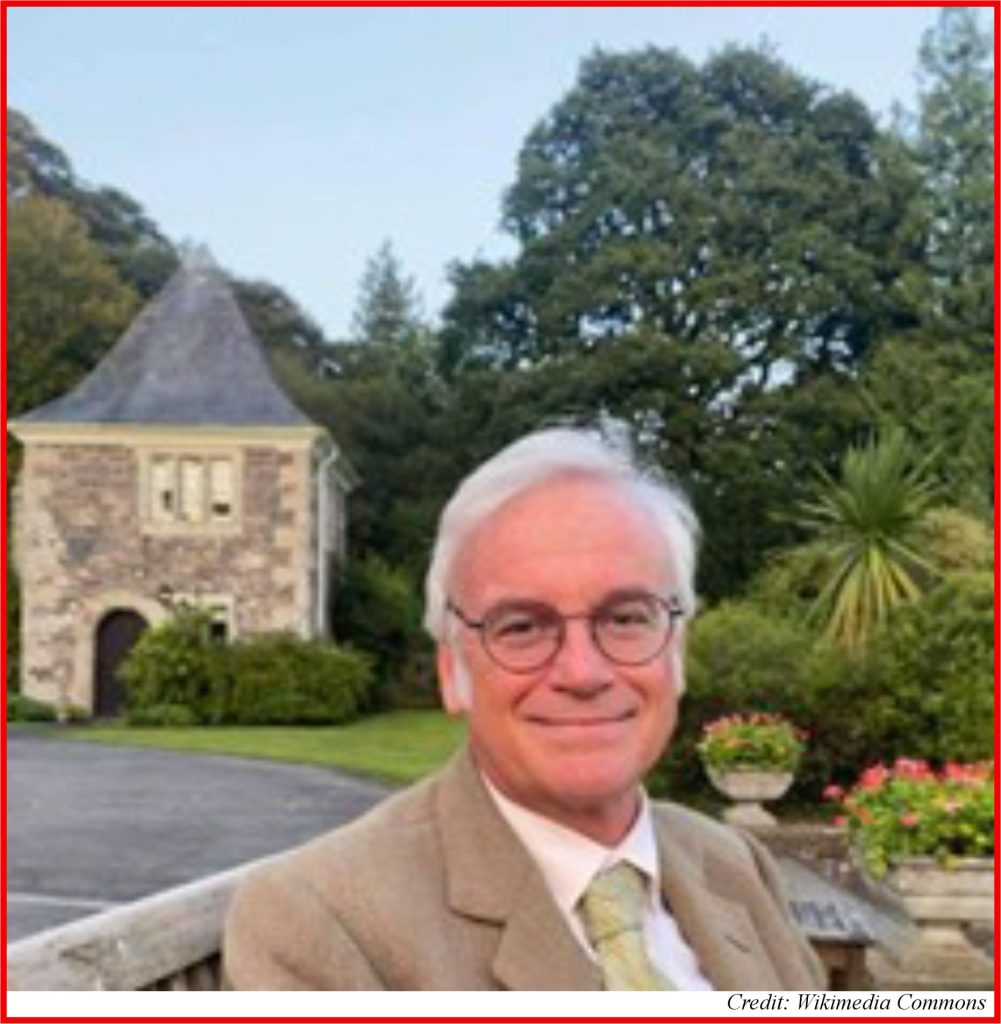
For STS’ theme of ‘JOY’ this month I thought it would be especially valuable to have the view of my friend Russell Blacker.
Russell’s professional career was as a consultant psychiatrist and senior lecturer, for whom Christian advocacy was important in connection with various medical ethical issues and on behalf of various minorities. He is a local preacher in his Cornish community and a Bible teacher (where I witnessed his proficiency in Ancient Greek and Hebrew as he led our group in reading chapters of the Old Testament’s Zechariah.) For many years Russell’s also given Bible teaching and lectures in different contexts, and often travels to India to support the Church of South India and Tribal Christians.
Alongside and inter-related with this work is multi-talented Russell’s enthusiastic musicality: the composing, conducting and choirmastering, the editing, directing and the performances which cumulatively produce his impressively wide-ranging practice of musicology. And all of which provide reasons more than enough for me to ask Russell to follow his thoughtful contribution with (below) a playlist of specially selected joyful music.
‘Joy is a highly valued and heightened sense of pleasure and happiness which, in this life, remains a mostly temporary or even fleeting experience. Most of us know what it is – but it lies beyond our ability to control or reproduce it at will.
Nostalgia feeds on times in our past when joy seemed to be a more reliable experience – childhood perhaps, or when we were first in love – or even further back in time to an imagined paradise or golden age when all seemed right with the world.
The past cannot be recovered but most, but not all, of the major religions look forward to an afterlife where joy is an abiding constant.
This is because joy, ultimately, is an expression of God; it is therefore experienced most reliably in relationship with God. As Jesus said (John Chapter 15 vs 11) – ‘I have told you this so that my joy may be in you and that your joy may be complete.’
Christ spoke of Heaven, where God resides, as a place of joy; in this life we can participate in the joy of God through the Holy Spirit, joy being one of the fruits of the Spirit, as St Paul explained.
Because joy is an expression of God it has close links to love – and to creativity.
It is a joyous God who created the universe, and humans, made in the image of God, can find joy in creative activity of other humans who share that capacity for creation: music, art, architecture, gardens …the list is extensive.
Some of the great composers, for example, used to sign off their work with the words Laus Deo, recognising that their creative gift came from God and is returned to Him in gratitude and worship.
Joy can also be found in admiring creation (landscapes, flowers) and participating in the creativity of others.
This explains why people who are not religious can nonetheless find joy in attending admiring or listening to creative works by others. This reflexive joy, too, is spiritual – as St Paul writes, ‘God has not left himself without testimony: He has shown kindness by giving you rain from heaven and crops in their seasons; he provides you with plenty of food and fills your hearts with joy.’
What brings joy to one person often differs from what moves another – this is an indication of the infinite variety in God.’
Russell’s own 5-hits sample playlist of joyful music includes the following:
Hugh Kellyk – Gaude flore virginali
Michael Praetorius – In Dulci Jubilo cum Tubae
J S Bach – Jauchzet, frohlocket – from the Christmas Oratorio
Olivier Messaien – Turangalila Symphony: final movement ‘un grand joye’
And the many CDs of World Music produced by Putumayo – e.g. ‘Islands’
ENDNOTE
In Russell’s playlist above his first choice is a hymn of praise to the Virgin Mary entitled Guade flore virginali by Hugh Kellyk (1480 -.) Kellyk is one of the 25 composers whose work makes up the Eton Choirbook, a richly illuminated manuscript collection of English sacred music (in the form of Latin vocal music) completed c1504 for use at Eton College. Many of the Choirbook’s pieces – some third in total – are damaged and incomplete.
Another of polymath Russell’s talents has been put to good use in what is described by Gary Higginson as ‘an amazing resurrection from the ashes’ in that he was able, in a labour of love, to reconstruct from their remaining fragments eleven pieces of this missing music.
Nine have now appeared on a newly-released album from recording company CRD (CD 3555) entitled Heavenly Light – Eton Choirbook Reconstructions.
Guade flore virginali appears on the album, this time a rendering by Richard Davy (1465-1407). Robert Wylkynson (1450-1515) is featured four times on the album, this showcasing of ‘his star’ by Russell doubling the known music by this composer.
‘The cultural importance of the Eton Choirbook cannot be over-stressed,’ writes Russell. ‘The music is hauntingly beautiful.. with the pieces’ high degree of melodic invention and rhythmic complexity, placing them beyond the reach of most choirs nowadays.’
Under conductor Daniel Gilchrist the choir Selene was the one chosen to rise to the challenge of performing Russell’s reconstructions.
Formed in 2022, Selene’s twelve singers gave their first performance that year at Oxford’s Magdalen College chapel. The choir’s stated aim is ‘to engage the audience in the drama of the music with such ferocity as to leave no hope of escape.’
Since 2023, with a shifted focus to the music of the Eton Choirbook, the choir’s long-term project is to perform more of Rusell’s reconstructions. A second album from CRD is in preparation.
…AND A CELEBRATION of ‘ODE TO JOY’ by LUDWIG VAN BEETHOVEN (1770 -1827)
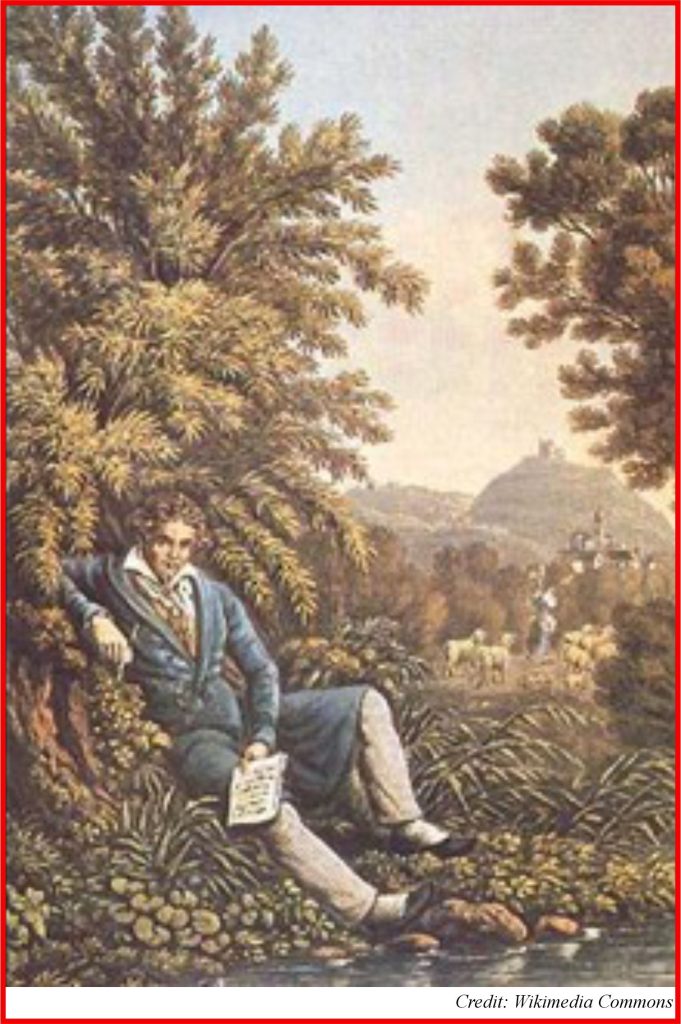
Maria Popova is an award-winning Bulgarian blogger. For nigh on two decades she has been issuing a weekly ‘Marginalian’ blog (www.themarginalian.org) dedicated, in her words, ‘to encouraging cross-disciplinary curiosity and self-directed learning.’ Her posts are thorough and thought-provoking, left field and resolutely upbeat.
She describes her blogging as the product of her reading, and of her reckoning with a perpetual search for meaning, conducted ‘always through the lens of wonder.’ Popova studied at the University of Pennsylvania and has been based for many years in Brooklyn, New York.
Almost always Popova’s posts, generous, erudite, highly illustrated, showcase the creativity of others: writers, poets, musicians, artists, philosophers.
It’s rare that she writes in the first person. But for her blog of 17 May 2022 the tone was different: in this issue she wrote movingly about the relationship she’d long ago established with Beethoven’s Ninth Symphony, his Ode to Joy.
Popova describes what it was like in 1989 when, as a young girl ‘in the spring of life’ living in Sofia, the capital of her country newly-liberated from Communism, she’d ‘stood alongside a dozen classmates in the National Symphony Hall to perform the Ode to Joy, recently adopted [in 1985] as the anthem of Europe by the European Union, the union to which my country longed to belong.’
The lyrics Popova’s choir sung were originally adapted from a poem by the German poet Friedrich Schiller, written in 1785, and discovered that year by Beethoven, aged fifteen at the time.
At its heart the poem is, albeit covertly, a paean of praise to freedom, its aims aligning with the transcendental idealism of the era of Enlightenment. This doctrine claimed that peace and kindness would envelop humankind as an inevitable consequence were freedom, justice and human happiness to be placed at the centre of personal and political life.
Joyful, joyful, we adore Thee,
God of glory, God of love;
Hearts unfold like flowers before thee,
Opening to the sun above.
Melt the clouds of sin and sadness;
Drive the dark of doubt away;
Giver of immortal gladness,
Fill us with the light of day!
The young Beethoven registered these sentiments and as Popova explains, ‘took Schiller’s bright beam of possibility and magnified it through the lens of his own genius to illuminate all of humanity for all of time.’
Conductor Leonard Bernstein, who famously conducted the Ninth Symphony at the breached Berlin Wall on Christmas Day 1989 (re-wording it in its final movement as ‘Ode to Freedom’), said of the music Beethoven wrote 37 years after first hearing Schiller’s verse, that as a composition, the Ninth Symphony represented ‘the closest music’s ever come to encompassing universality.’
After the long gestatory period Beethoven finally began work on the symphony in 1822. When achieved, it was to become not only his personal greatest creative and spiritual triumph but also ‘a turning point in the history of music that revolutionized the symphony… an eternal masterwork.. making meaning out of chaos, beauty out of sorrow… Inside its total drama, a total tranquillity,’ in Popova’s lyrical prose.
Although Beethoven had not composed a symphony in a decade, although his hearing was by now almost completely gone – and over and above all – regardless of the fact that no composer before him had ever woven lyric poetry, or indeed any words at all, into a symphony, he was determined his Ninth would culminate with the full force of a crowning final chorale.
Only in song, Popova tells us, ‘could Beethoven integrate the solace of poetry with the drama of music, and channel his own poetic rage as a force of beauty to turn the human darkness he’d witnessed and suffered into something incandescent.’
Ambitious, stubborn, undeterred, he puzzled on about he’d introduce the words, and how choose the voices that would best carry them.
Eventually the work’s premiere took place on 7 May 1824 in Vienna. Four soloists were to anchor the sizeable choir while the orchestra was huge in size: 24 violins, 24 wind instruments, 12 cellos and basses, ten violas and a whole lot of percussion.
Popova describes the scene, ‘Something shifted as soon as the exalted, sublime, total music rose… subsuming every soul into a single harmonious presence.’ Before even the Ode’s final chord had died away the theatre’s gasping silence cracked open into wild applause as the audience members, having leapt to their feet, chanted Beethoven’s name while waving fluttering handkerchiefs above their heads.
And the rest, as they say, is history. The Ode remains to this day a protest anthem and call to solidarity; in our times the need for its clarion call has remained paramount.
In Ukraine, for example, in recent years its version re-imagined by composer Victoria Poleva has been played to defy Putin’s tyrannical invasion; in earlier times its chorus was sung by Chilean protestors as they took down the Pinochet dictatorship; Chinese youth in Beijing’s Tianenmen Square sounded it out as the tanks rolled in in April 1989, while a 2018 performance in the Royal Albert Hall for London’s Proms commemorated the centenary of WW1.
For those in the UK, 2026 presents three opportunities to attend a Ninth Symphony performance:
Friday 12 June: the Royal Scottish National Orchestra at the Usher Hall, Edinburgh
Saturday 13 June: the same orchestra at the Royal Concert Hall, Glasgow
Saturday 19 September: the Royal Philharmonic at the Royal Albert Hall, London
Popova concludes her blog with this contemporary comment, ‘Even as we live through nightmares there is something in us more powerful than tyranny and destruction, as long we remain ultimately unassailable – and this we can become by placing freedom, justice and personal happiness at the centre of our commitment to life.’
Experiencing another spring, she signs off with this personal note, ‘On my wireless headphones as I cycle across the Brooklyn Bridge I am hearing a recording of the Berlin Philharmonic playing the Ode.
I ride into a life undreamt of by the girl who sang its chorus in Sofia’s National Concert Hall, a life of infinite possibilities…
I ride into the spring night, singing. This in the end, might after all be the truest translation of ‘joy’ – this ecstatic fusion of presence and possibility.’
PEOPLE
YOTAM OTTOLENGHI
b.1968
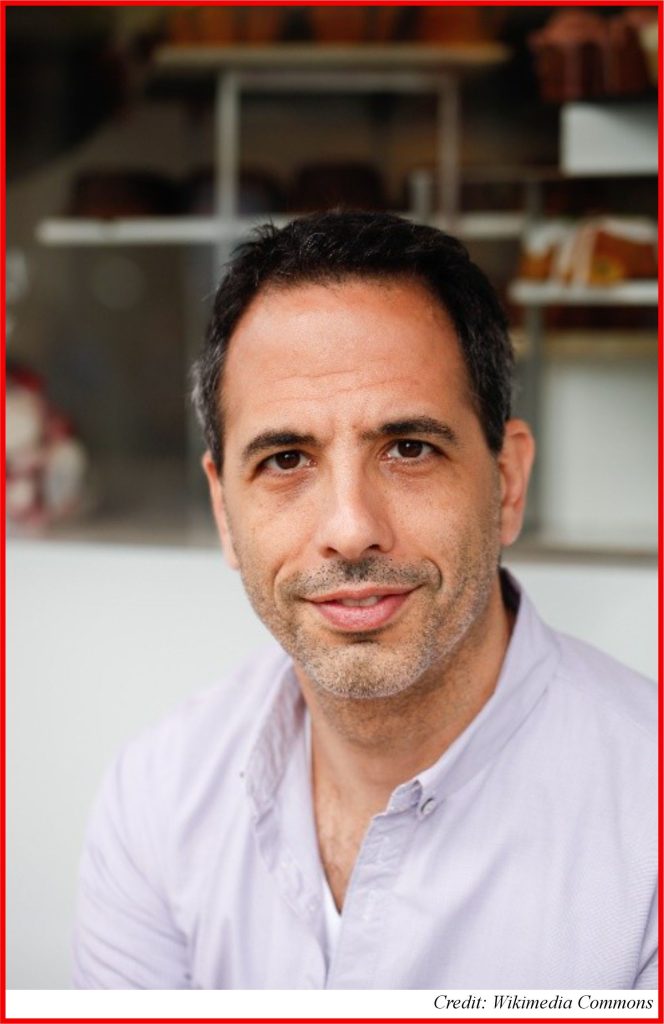
In one of his recent newsletters, entitled The Comfort We Collect, Yottam Ottolenghi writes heartwarmingly, ‘I love hearing about other people’s nostalgic recipes. Not just the dishes themselves, but what makes them work and why they matter. We collect comfort as we get older.’
Hitting on something foundational about the multi-cultural yet non-traditional approach that characterizes his cuisine he says, ‘My own food memories take in all the places I’ve lived in and travelled around – but they also include stories others have told me - friends whose food has become such a big part of my cooking consciousness, colleagues who get emotional talking about food from their childhood.
It’s all these moments of eating together, cooking, talking excitedly with others – they all build up, they stick, and they shape the way we cook.
Excited, emotional talk, hmm… what do you think? was it ‘excitement’ that we were looking for in a chef/recipe writer/cooking guru back in the day before ‘Ottolenghi’ became the accepted, familiar and shortcut way to describe unfamiliar, intriguing, even sometimes startling food?
Certainly, across the years there have been cookbooks that have changed our perceptions and knowledge about great food, and the challenge and rewards of cooking it.
Books with JOY in their titles, for example, such as the 1931 mothership, The Joy of Cooking by Irma S Rombauer (Scribner, New York, revised edition 2019) or the recent memoir by people-pleaser favourite, Nigel Slater, A Thousand Feasts: Small Moments of Joy (Fourth Estate, London 2025.)
Then, for those interested in the evolution of our current cuisine we do, of course, still live with the legacy of the formidable cook/writers who emerged in the 1950s from the privations of the culinary wasteland that was the post-war US and UK, namely Julia Child (1912-2004) and Elizabeth David (1913-92.)
These two women were indomitable and widely influential chefs, determined to spread sophistication while reviving appetite for a classical repertoire. Along with immense capacity for research and attention to detail as writers, they did express joie de vivre, for sure – but clearly, the objective of reading and learning from these tomes was serious, was to succeed in serving the ‘right’ food in the ‘right’ (effectively same old, same old) way.
So, it is undeniable that for sheer pzazz, for bringing an explosive energy and introducing extraordinary, ad hoc, revelatory, new, seemingly devil-maycare flavour combinations and presentation dimensions into the western way of eating, cooking - and even thinking about – food, it’s largely all been down to Ottolenghi.
Ottolenghi the whole package, that is: after the delis came the restaurants, the books, there’s advance now into social media, television, the embrace of a waiting market in the USA. Read on to learn how this now immensely popular and feted innovator, chef, restaurateur and cookery commentator followed an unorthodox route to arrive where he is today.
Born 1968 in Israel, Ottolenghi is a cosmopolite of Italian Jewish and German Jewish descent. After his military service he completed a degree in comparative literature at Tel Aviv University, his thesis on the philosophy of the photographic image. (To this day he himself oversees the photography for his recipe books, the New York Times noting that he ‘eschews [!] using a food stylist’ for this task.)
As a journalist, Ottolenghi lived in Amsterdam before attending the Cordon Bleu Cookery School in London to study French pastry cooking. (One does wonder how abrupt was the Damascene moment that inspired such a career-change move for him?)
He then went on to work at three Michelin-starred London restaurants before meeting Sami Tamimi, a Palestinian chef from Jerusalem. According to Adam Jacques in The Independent their bond was immediate, largely the result of discovering ‘a joint incomprehension of traditional English food.’
They ventured first into selling the foodstuffs they proposed as alternatives via an eponymous delicatessen in Notting Hill, west London.
Here the characteristics that set their approach apart from the run of the mill were quickly obvious: the foregrounding of vegetables and the unorthodox (unheard of, undreamed of even!) flavour combinations such as a savoury beetroot warm crumble, or a whole blood orange dressed with creamy Italian cheese and coriander seeds crushed and toasted. Much of the pleasure of the offerings derived from the deli’s abundant use of Middle Eastern ingredients: rose water, za’atar and pomegranate molasses.
Ottolenghi had been a food columnist for the Guardian since 2006 and published his first book under his own name in 2008. NOPI (an acronym for ‘north of Piccadilly’) was the name he gave to his first restaurant, a small but dashingly glamorous West End establishment off London’s Regent Street, a place of many happy dining memories.
It is from his NOPI: The Cookbook (Ebury Press London, 2015) that the recipe below is taken. In its simplicity and few ingredients it confounds some Ottolenghi critics who’ve commented that his recipes are more for restaurant showiness than for concocting food for eating simply but well with family and friends.
Try this one – then decide on that for yourselves:
ROASTED AUBERGINE with BLACK GARLIC DRESSING
Ingredients
5 medium aubergines, trimmed
120ml olive oil, plus more to serve
150g natural yogurt
6-7 basil leaves
20g toasted pine nuts
sea salt, black pepper
Method
- Pre-heat the oven 220C/200C fan/Gas Mark 7
- Cut the aubergines in half lengthways and then again widthways. Cut into wedges and tip into a large mixing bowl. Add the olive oil, 1 tablespoon of sea salt and a good grind of black pepper. Mix well.
- Line 2 baking trays with baking paper. Spread the aubergines skin-side down on the trays; do not overcrowd them. Roast in the oven for 40 minutes until well-cooked and golden brown. Remove from the oven and set aside to cool.
- To make the dressing place all the ingredients in a small bowl and add ¼ teaspoon of salt. Pulse with a stick mixer until a smooth paste forms.
- Tip the cooked aubergines into a large bowl and pour over the dressing. Use your hands, mix gently so that the aubergines do not break up. Leave to stand for 1 hour before serving.
To Serve
- Spread the yogurt out on a platter and arrange the aubergine wedges on top
- Using your hands, tear the basil leaves into pieces and sprinkle over the aubergines. Sprinkle over the toasted pine nuts. Finish with a drizzle of olive oil.
PLACE
OMDURMAN, SUDAN
It was a very long time ago when I first went to Sudan. This I reflected upon, angry tears brimming, while watching the news on television last night, Channel 4 News’ in-depth report on the country’s calamitous current situation to be precise: the suffering of thousands imprisoned by militias described, the evidence of ethnic cleansing displayed casually to camera, the machinations of self-serving, gratuitous and ultimately futile international politicking explained at length.
Forty years ago I’d landed in Khartoum along with a film crew tasked with capturing the various interventions my aid organization were targeting for delivering a clean water supply to rural communities. ‘Sweetwater Safari’ was the title we’d chosen for it.
We were to travel to the far west and far south of this sprawling country, at 18,86068 sq kms, Africa’s third largest. It was peaceful – albeit nearing the end of what was only a decade-long hiatus in ongoing years of civil warfare; there were no constraints to moving about.
First though, there’d be the days in the capital waiting on our authorizations, sitting stifled by thrumming heat on the cracked vinyl seats of the hard benches always there in the corridors of government offices.
And even before that could begin there was a Friday. I was a bit green in my job back in those days – I hadn’t taken on board that on a ‘mission’ there’d be opportunities to do other things than work, that those ‘things’ could perhaps even be part of the work. And that the cultural learning curve would be steep. Because mind you, there was no Google to access and pre-digest anything we might be going to see – it was all to come fresh.
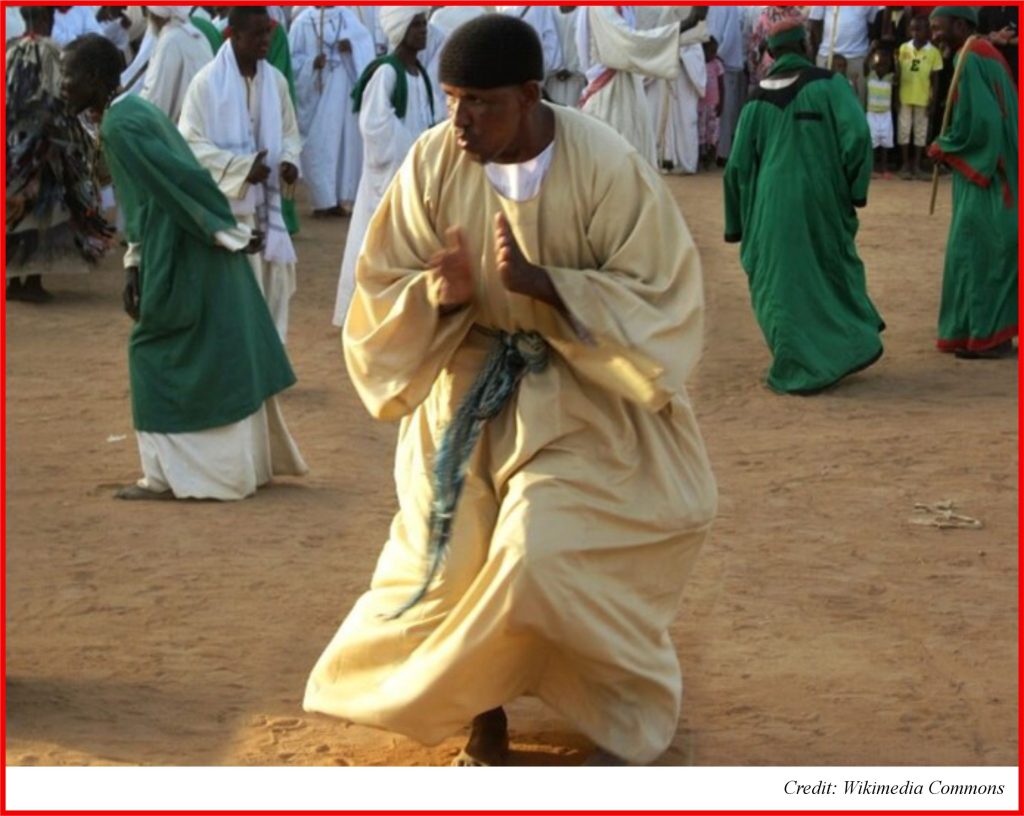
So, I was unprepared to be taken for a jaunt: the short-ish ride west out to Omdurman, crossing the bridge over the White Nile. And I was entirely unbriefed about what would unfold once we reached the mosques at the site of the historic Sheikh Hamad-al Nil tomb.
This 2019 youtube video gives you a taste of what the ceremonies look like there in the recent past.
Yoho Media
Whirling Dervishes; Islam in Sudan; Sufis worshipping in Sudan
What’s happening is known as ‘dhikr’, when Sufis mass in one place, men, women, families, to celebrate with phrases and prayers repeatedly spoken and chanted expressively. They clap loudly in rhythm as they move, shuffling and stamping back and forth.
Dhikr has a central place in Islam, the recitation an act of remembrance and acknowledgement of the believers’ faith in Allah. Man has an innate knowledge of God and performing dhikr unlocks this remembrance, in which there is great joy taken. There is sensuality in the uninhibited, spontaneously interpretative movements that the individuals who whirl and dance choose, in their variegated modes of their brightly coloured jalabiyas, their adornments and sometimes wild hair, and there is sensuality in that everything is perfumed with the fumes of frankincense billowing above the massed, gently swaying and moving ranks of the audience.
I see in the video that it’s nowadays all built up around the mosques and tomb, unlike the open sandy expanses there when I visited. We clambered on to the roof of the Landrover to get the best view for filming – but back then there were no great crowds, certainly no tourists.
In 1980 Sudan’s population was under 20 million, today it’s over 50 – no surprises that the conurbation has sprawled.
Sudan is a nation 97% Muslim, divided between two sects, one of which follows Sufism. The peace and joy the poet promoted sits so very sadly at odds with the harrowing, seemingly intractable tragedies that continue to unfold in the country. The Channel 4 broadcast shared statistics of dimensions today that are almost too difficult to take in: 8.6 million people displaced, for example, 18 million facing severe hunger.
The video ends with an image that corresponds precisely with my memory of that afternoon we spent in Omdurman; I recall how suddenly darkness fell, no twilight, straight from an ochre-yellowish glow reflecting off the sandy stretches all around, palms and the minarets briefly silhouetted against it, to black anonymous night.
On another day we were taken to the riverbank mid-city, to be shown the place mid-river where the Blue and the White Nile meet and mingle to form the great river that flows on through the length of Egypt to empty into the Mediterranean. That confluence still happens just the same now, something set in place eternally, it gives me some comfort to think, while grieving at the plight of a nation whose people are suffering terribly, apparently irretrievably locked in unending warfare.
NOTES AND JOTTINGS
WHAT DO LEADERS, POETS, THINKERS SAY ABOUT JOY?
Buddha:
We are shaped by our thoughts; we become what we think. When the mind is pure, joy follows like a shadow that never leaves
Mother Teresa:
Joy is a gift of God, flowing from a good conscience
Pope John Paul II:
God made us for joy
Michelle Obama:
Joy fosters connection. Sharing moments of happiness can bridge divides, build communities and inspire collective action
William Blake:
He who kisses the joy as it flies,
Lives in Eternity’s sunrise
Albert Einstein:
It is the supreme art of the teacher to awaken joy in creative expression and knowledge
Pope Francis, quoting C S Lewis:
Joy is the serious business of Heaven
Oprah Winfrey:
Joy is a sustained sense of wellbeing and internal peace – a connection to what matters
Eckhart Tolle:
Pleasure is always derived from something outside you, while joy arises from within
Saint Francis of Assisi:
Where there is hatred, let me sow love; where there is darkness, light; and where there is sadness, joy
Emily Dickinson:
Find ecstasy in life; the mere sense of living is joy enough
Anne Frank:
I hid within myself .. and quietly wrote down all my joys, sorrows, and contempt in my diary
William Wordsworth:
With the deep power of joy we see into the life of things
Plato:
Love is the joy of the good, the wonder of the wise, the amazement of the Gods