
MAR
Introducing
MARCH 2025
The spring equinox falling on 20th March, with summertime beginning on the 30th, this is a high energy month, associated in the northern hemisphere with swirling winds and in the fields, ‘mad’ hares’ ‘dancing’ on their hind legs, likened to the cut and thrust of a boxing match.
(Chloe Dalton’s touching new memoir Raising Hare (Edinburgh, Canongate 2024) will give the curious the lowdown on what these antics actually represent in the noble hare’s lifecycle.)
On 3rd March it’s World Wildlife Day, by the way.
In the southern hemisphere, on 14th March it’s India’s Holi Festival of Colours. An ancient Hindu tradition, Holi’s dedicated to love, forgiveness and happiness. Crowds fill the streets to throw handfuls of coloured pigment and spray water. Pink, red, purple, green, blue – with pink predominating. Shocking pink, that is, the shade of the bougainvillea flowering in the image on the HOME page. Ubiquitous in India, the shade is reputed to be the colour of unconditional love.
Here’s what unconditional love sounds like. Listening to Sufi music performed by ‘Pakistan’s nightingale,’ Usted Nusrat Ali Fateh Khan (1948-1997) you have a piercing rendering of the pain of separation from the beloved, be that that romantic or spiritual, human or divine.
Sufi music performed by Usted Nusrat Ali Fateh Khan (1948-1997)
Known as ‘the voice which opened the world’s ears to the rich hypnotic sounds of the Sufis’
Nusrat sang lyrics in Urdu such as these,
Come as soon as possible, my eyes are waiting for you
Don’t meet me as a question, don’t meet me as an answer
And if you meet me in a new season, meet me as a rose’
Holi’s jubilation is a reminder of the fact, should we need reminding, that being drenched in brilliant colour lifts our mood.
Must artist Lorenzo Lotto (1480-1536) not have relished this, readying to spread his chosen primary hues on his palette to paint his great altarpiece, The Annunciation to the Virgin?
The Annunciation, the Christian festival celebrated on 25 March and the ART OF THE MONTH subject, is the third great revelation in the Anglican church year’s calendar. Lotto’s portrayed the scene in a way highly unconventional in its time – both for its singing colour and its distinctly high energy.
Is such energy, such an intake of breath, always present when a revelation is to take place, when what is revealed will mean the things of before are to be changed for forever?
This month’s LITERATURE features a novel by contemporary author Amin Maalouf. The revelation his characters seek, a sacred Islamic name for the Prophet, requires the effortfully anxious energy involved in undertaking a long journey in the context of a countdown to disaster – and is the cause of many a breathy, long-drawn-out sigh.
Under PEOPLE, read about Saint John, author of the Bible’s Book of Revelation, foretelling – for believers and non-believers alike – the end times, the last trump of the Second Coming, the arrival of Judgement Day for both living and the dead.
PLACE is a personal account of a journey in Greece to find the shrine where the mystical revelations of great Oracle of Delphi’s once wafted in wraiths of smoke across the dark slopes of Mount Parnassus. A pilgrimage to re-imagine the energy and aura of Pythia, keeper of the sacred fire, to stand in the place where she held in thrall all those who came to seek her counsel.
JOTTINGS AND SAYINGS for this month focus on breath and breathing.
ART OF THE MONTH
In the calendar:
The angel Gabriel is sent by God to announce to the Virgin Mary she’ll conceive a son by the power of the Holy Spirit to be called Jesus. The 25th March Feast of the Annunciation is one of the principal feasts of the Christian church.
THE RECANATI ANNUNCIATION TO THE VIRGIN by
LORENZO LOTTO

The frame of reference: The Gospel according to Luke Chapter 1, vs 11 reads, ‘Then the angel said to her, ‘Do not be afraid, Mary, for you have found favour with God. And behold, you will conceive in your womb and bring forth a Son, and shall call His name Jesus. He will be great, and will be called the Son of the Highest; and the Lord God will give Him the throne of His father David.’ Mary consents, ‘Here am I, the servant of the Lord; let it be with me according to your word.’ From this moment was precipitated the Incarnation of Christ and the redemption of the world.
The painting: Today in the Civic Museum, Villa Colloredo Mels, Recanati, Italy, the work dates from 1534.
Is Mary afraid? Lotto captures her alert, as startled perhaps as her cat. Turned away, her raised hands look more like admonishment for the violation of her privacy than a display of fear, don’t they? The invasion’s shock value is emphasised by Lotto’s depiction of an interior space of quietly tranquil domesticity.
The Annunciation subject was one painted by almost all the great masters. Lotto’s composition transgressed the norm in many ways, as for example placing the angel on the right, not left, facing forward not in profile. Usually, God’s presence is indicated by a dove or rays of light, Lotto instead gives us a muscular, imposing God, fully revealed, fully engaged in the message delivery. While depicting Mary active, so different from her passivity as in many representations, Lotto uses the power of red clothing to shout out the event’s celebratory nature. And, by giving Gabriel a shadow, Lotto reveals himself as an artist ready to break the mould of myth, declaring with his bold Annunciation the reality of this portentous moment in history.
The artist: During his lifetime (1480-1556) Lotto was well respected, enjoying a popular mid-Renaissance Northern Italy career, producing many significant portraits, altarpieces etc. Born in Venice and traditionally included in the Venetian School, Lotto became characterized as somewhat of an outsider because of his highly stylistic individuality. He undertook wide-ranging travel, 1508 being when he first painted in Recanati, but going on to spend periods in Treviso, the Marche, Rome, Bergamo, Venice and Ancona. Always intensely religious, in 1522 Lotto joined the sanctuary of Loreto for his final few years; he was buried there in the habit of a Dominican monk.
In the Recanati Annunciation, produced mid-career, are epitomized several of Lotto’s most personal traits: his accomplishment as a rich colourist, his fine eye for depicting detail, and the perspicacious quality of his vision: able, while working within the classical tradition, to captivate an audience by departing from said tradition’s cool detachment to evoke with great vividity in paint applied to canvas the thoughts and emotions of his characters.
LITERATURE
AMIN MAALOUF (1949 – )

A revelation can also take the form of a written document.
Or so historical fiction writer Amin Maalouf would have us believe. Maalouf’s Balthasar’s Odyssey, translated by Barbara Bray and first published in France in 2000 (London, Harvill Press), opens in late 1665, a few months before the ominous ‘Year of the Beast’, 1666,¬ when people everywhere are thinking hard about how to protect themselves from the disasters predicted in the lead up to the year end’s cataclysm, when they expect to face the Last Judgement.
The tale’s narrator, Balthasar Embriaco, a Levantine merchant, believes that what he’ll find in one elusive book, Abu-Maher al-Mazandarani’s ‘The Hundredth Name,’ will protect him from harm. In Islam there are 99 names for God: it is said that those to whom the 100th name is revealed are ensured of salvation.
Determined to find and read it, one of the rarest books ever printed, Balthasar embarks on his odyssey, heading first to Constantinople with his two nephews. Shortly joined by the ‘wilful’ young woman, Marta, this group then travel the known world. It is the search for the volume which is responsible for all their adventures and misadventures, including piracy on the high seas and narrowly escaping the Great Fire of London.
Balthasar’s story is recounted through the journals in which he confides, endearingly frank accounts of his self-doubt about the many mis-steps made as he progresses clumsily on. ‘It can happen that God feels well disposed towards someone apparently quite undistinguished. He sends signs to him… transforms his dull life into a memorable epic. We must not ask why one person is chosen and not another,’ one nephew consoles him when despondent about repeatedly failing to gain his objective.
As anyone facing up to the Apocalypse’s ticking clock might, Balthasar has questions such as, ‘We are now in the last few weeks .. is this the right moment to begin a new life?’ Confronting death, he asks, ‘What can books matter, or fame, if the whole world is about to go up in flames?’ By October he’s fevered and his entry says, ‘But how late it is! I’ve been writing like someone eating after a fast. It’s time I left the table.’
What precise fate, what revelation, if any, is Balthasar’s denouement must be left for a reader to discover – albeit reassured that, humankind inevitably surviving, while not all desiderata are achieved, some contentment is.
A Lebanese-born French, Maalouf’s education was in Beirut at a Jesuit school. He writes in French, his work translated into more than 40 languages. A journalist until 1975 when he moved to Paris, his first book (non-fiction) published in 1983 was followed by further non-fiction, musical compositions and numerous novels.
Maalouf’s historical novels, according to Ian Sansom in The Guardian, ‘prove love can transcend ideology and religion and overcome hate and fear. His work .. the very definition of synthesis’, Sansom concludes, conveys important modern messages via ‘his belief that through examining .. a particular historical period we can gain a better understanding of our present time.’
In 2010 Maalouf’s body of work, described as ‘an intense mix of .. historic affairs in a Mediterranean mosaic of languages, cultures, religions, and stories of tolerance and reconciliation,’ was awarded the Prince of Asturias Award for Literature. Elected the following year a member of the Academie Francaise, in September 2023 he became its Perpetual Secretary.
PEOPLE
SAINT JOHN THE APOSTLE (6 – 99)
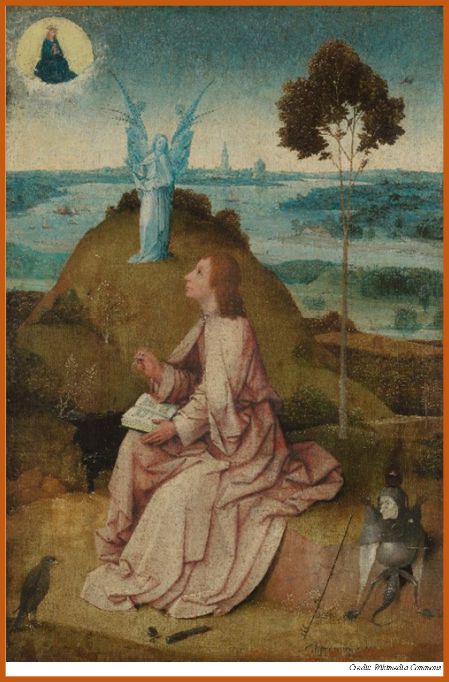
Saint John, recognised as the author (although contested by some scholars) of the Book of Revelation, is depicted by Dutch artist Heironymus Bosch in 1500 (Gemaldegalerie, Berlin.)
Blind, frail and aged, the Apostle is on the island of Patmos in the Aegean where he fled persecution with a few followers to live in hardship and await the Second Coming.
Bosch’s painting shows John’s face as tranquil. Undismayed by the squat serpent-tailed creature behind him, his expression belies inner turmoil, his energy clearly all devoted to embodying his Saviour’s message of joy for eternity. By now almost a mystic, his time as the one chosen by Jesus to be the youngest of the apostles is more vivid to him than daily life.
Quill in hand, John writes in Greek letters of encouragement to the seven scattered clandestine churches which are struggling to uphold the Christian faith in the face of intolerance. The letters form part of his Book, the final book of the New Testament.
Also inscribed into John’s Book were his apocalyptic visions, referred to as ‘things which must shortly come to pass…which God gave unto him’ Revelation Chapter I, vs1.
Here is miniature of Revelation, one of many illuminations in the San Paolo Bible, created in C9th France.
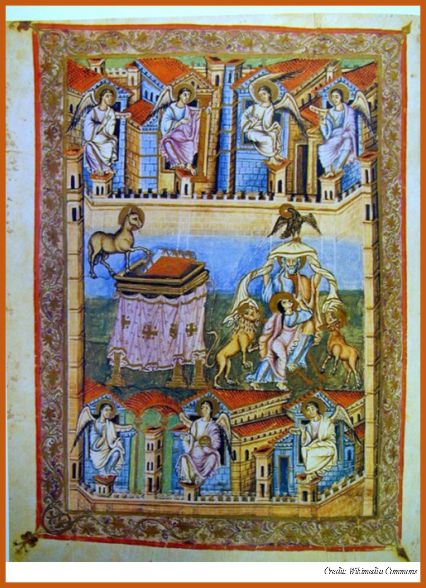
The folio references the dragons and other beasts mentioned such as ‘…I saw heaven opened, and behold a white horse; and he that sat upon him was called Faithful and True, and in righteousness he doth judge and make war’ Revelation Chapter 19 vs 11 and ‘Then I saw a beast come out of the sea with ten horns and seven heads; on its horns were ten diadems, and on its heads blasphemous name[s]. The beast I saw was like a leopard, but it had feet like a bear and its mouth was like the mouth of a lion.’ Revelation Chapter 13 vs 1-2.
Should we take John’s Book as an interpretation of history, prophetic vision about future events or an allegory of the spiritual path Christianity offers? It certainly serves as a reminder of Christianity’s preoccupation – and hope – as being concerned with final things. Some argue Revelation symbolically represents humankind’s fate as the irrevocably dire struggle between good and evil.
An opportunity to make your mind up about this, while coincidentally gaining an understanding of the seemingly tenuous, happenstance nature of Christianity’s very survival in the first century after Christ, is provided by Niall Williams’ novel John (London, Bloomsbury 2008).
Williams’ re-telling of the Saint’s extraordinary last years is a compelling, comprehensive and compassionate account, these words about John among its concluding lines, ‘There will be argument and debate as to who wrote what, and fragments of antique testimony offered in frail proofs. But none will matter.. the words will last to the very edge of eternity .. John knows the world will not finish here .. He sees what is to come.. the numbers of the Christians grow .. the churches thereafter, the great Cathedrals, the psalms, the songs, the composed Masses, the raptures and revelations of art divine yet to come….’
PLACE
THE GREAT ORACLE OF DELPHI

She was the spokesperson for the cult of the god Apollo, son of Zeus, god of oracles, Apollo the beautiful and eternally young, carrier of a golden bow and a quiver of silver arrows. She spoke in riddles, ‘ainigmata’ in Greek. Her audiences, the great and good who’d come to what they called the ‘centre of the world’, her remote mountain location, journeying from the faraway capital, Athens, had to wait on the opportune moment for her prophesy: once a month, only for nine months of the year, and only when she deemed the omens were good.
They came to hear what would be the outcome of their wars, their political actions or setting of laws. Public policy was often swayed by her utterances. Her fame spread, her shrine’s motto was ‘Know thyself.’
They called her Pythia. For the 400 year duration of the Delphic shrine’s heyday (C8 – C4 BC) there was always an Pythia in residence, the one for the oracular role elected from among older women.
Bathing in the Cassotis spring before prophesying, Pythia drank its sacred water and entered the tall-columned Temple. There was ritual cake ‘pelanos’ to share out, and a beast to be sacrificed. Pythia was obliged to dress in maiden’s clothes and when prophesying, to sit in a narrow cave and chew on laurel leaves, straddled over a sacred fire through came fumes seeping from a fissure in the rocks below. Priests interpreted and set down whatever Pythia said, enigmatic words, perhaps, or only sounds, intelligible or otherwise.
Living apart from her husband and family, Pythia was yet not alone – the site thronged then with with visiting dignitaries’ entourages and curious onlookers.
It was a busy hub, the sanctuary of Delphi become a lucrative enterprise, with treasurehouses constructed and filled with offerings of gold and bejewelled weapons. C19th research had revealed the temple plan showing the steeply-inclined sacred way winding up Mount Parnassus’ lower slopes, lined with grandiose monuments and these treasuries where offerings were left, tokens of thanks for the favours bestowed by the god.
It was this I wanted to experience, this contrast of location with designated purpose, from almost beyond imaginable time, from almost three thousand years ago, this that had decided us to take the road north out of Athens on a February day when the wind off the Aegean was biting, and snow forecast. In no way a typical tourist jaunt – but this was anyway long before Delphi received its 1987 World Heritage site designation, long before rural roads were widened to accommodate big buses. I recall signposts were few as we approached the location, to what was just an isolated pile of stone, it seemed, perched up above us, almost hidden in a fold in the hills against the sombre backdrop of grey mountain against a greyer sky.
We were confronted with a scramble up steep steps to find what remained of the glory: once a sprawling site, not much now: the foundations, large paving slabs, and a few columns, but dating from much later than the heyday period, eight centuries later, in fact. Some capitals and massive wall blocks are preserved from the first temple which burned in 548 BCE, as are some pediment sculptures from the second C6th temple. The Athens treasury has been rebuilt and displays a wall covered with inscriptions including musically annotated hymns to Apollo.
There was no aromatic smoke to be seen or smelled. Windswept silence prevailed, two dark specks above were hawks circling high over our heads. Imagining anything festive and/or frenetic, envisaging the raucour of a mass of questing, heated, celebratory humanity in the atmosphere was hard that day in this place, stumbling about on its bare rock, snow-wreathed and bleak – easier by far to be convinced the Oracle had determined at this point it’d prefer to hold on to its mysteries. (In 2001 scientists identified ethylene gas in the region. Once used as an anaesthetic and inducing trance-like states, they considered this could have been what prompted the behaviour Pythia presented with when making her pronouncements.)
Our time seeking Pythia’s presence was not for a moment wasted though, as ones for the memory book go – and then there was the consolation of a memorable lunch.
In an almost empty café in a village where, except for the proprietor, we saw no-one stir, we huddled to thaw out around the pot-bellied stove over which he cooked our meal. Shaking and tossing a heavy pan, he sizzled up the best, most-salivating, spiciest small sausages you could ever imagine, to serve with a raw cabbage salad dressed only with salt, offering us beakers of good Greek retsina to wash it all down. And then, on turning to begin our return route, behind us we were treated to the louring clouds clearing momentarily to reveal a vista yonder of the Gulf of Corinth outspread, twinkling pale blue in the day’s last gleam of sun, just one red sail in sight, far out against the wide horizon.
SAYINGS AND JOTTINGS
My words come from an upright heart; my lips sincerely speak what I know. the spirit of God has made me; the breath of the almighty gives me life – The Book Of Job Chapter 33 vs 3-4
Breath is life, and if you breathe well, you will live long on earth – Sanskrit proverb
Then God formed the man from the dust of the ground. He breathed the breath of life into the man’s nostrils, and the man became a living person – The Book of Genesis Chapter 2 vs7
Arise! the breath, the life, again hath reached us: darkness hath passed away and light approacheth – Rig Veda 1:113:16
The breath of life is in the sunlight and the hand of life is in the wind – Kahlil Gibran, The Prophet
So long as men can breathe, or eyes can see,
So long lives this, and this gives life to thee – William Shakespeare, Sonnet 18
RESOURCES
Humfrey Peter Lorenzo Lotto (Yale, Yale University Press 1997)
Scott Michael Delphi: A History of the Centre of the Ancient World (Princeton, Princeton University Press 2014)